

 Maurizio Pigliacampi
 Genoese pesto
Liguria is Italy’s longest-living region: could it be thanks to the pesto?
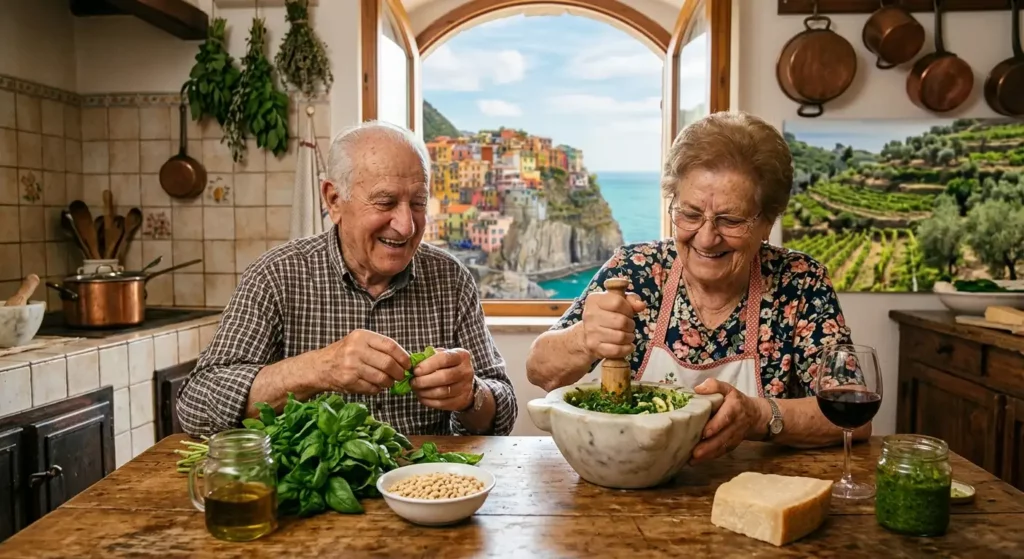
Liguria is one of the longest-living regions in Italy. According to the most recent ISTAT data (2025-2026), there are approximately 900 centenarians living here, representing one of the highest concentrations of elderly people in the country and one of the highest average ages in Europe. This record has attracted the attention of demographers and nutritionists for years.
The inevitable question is always the same: why do people live so long here?
Part of the answer lies in the so-called Mediterranean diet, and in Liguria, one of its most recognizable symbols is Pesto Genovese. It is a simple condiment, yet it is built upon ingredients that food science is now observing with great interest.
Extra virgin olive oil is rich in polyphenols and monounsaturated fats associated with cardiovascular protection. Basil contains aromatic compounds and antioxidants, including flavonoids and vitamin C. Pine nuts provide essential fatty acids and micronutrients, while garlic has a long history of culinary use linked to general well-being.
This is not a trivial detail, because these same ingredients are part of a dietary pattern that, as a whole, is associated with a longer life expectancy.
And here is the interesting point: it is not accurate to say that pesto cures or extends life, but it is just as reductive to completely exclude it from the picture.
Pesto is not an isolated food; it is a concentrate of a food culture: healthy fats, vegetables, nuts, and garlic, integrated into a diet that has historically been devoid of excesses and characterized by continuity over time. In other words, it is perfectly aligned with the Mediterranean model that has been studied for decades precisely for its health effects.
Furthermore, Liguria has an ancient maritime tradition, built on exchange, adaptation, and refined survival cooking, where simple ingredients are transformed into nutritious and stable dishes. In this context, it is not too far-fetched to imagine that even pesto, consumed with a certain regularity, might have a role, small but consistent, in the broader picture.
And so the provocation remains on the table: is it just statistics, or does pesto really have something to do with it?
The most honest answer is probably this: it is not pesto alone that creates Ligurian centenarians, but perhaps it is one of those pieces that, along with the others, is not out of place at all.
Because in the end, longevity does not come from a single secret, but from many habits repeated throughout a lifetime. And in Liguria, among these habits, pesto is certainly not an occasional guest.