

 Maurizio Pigliacampi
 Genoese pesto
How to Store Fresh Pesto: Complete Guide to Keeping It Green and Flavorful Longer
How to Store Fresh Pesto: Complete Guide and Practical Tips
Fresh pesto is a delicate product whose quality comes from the use of genuine ingredients such as basil, extra virgin olive oil, cheese, pine nuts, and garlic. Because it is a fresh preparation with no strong preservatives, it requires special attention during storage.
By following a few simple rules, it is possible to keep fresh pesto aromatic, vibrant green, and full of flavor for several days, preserving its organoleptic qualities at their best.
Why does pesto spoil?
The main enemies of fresh pesto are:
- Oxygen, which causes basil oxidation and browning of the product.
- Bacteria and microorganisms present in the environment or on utensils.
- High temperatures.
- Contamination from spoons or containers that are not perfectly clean.
For this reason, proper storage begins even before filling the jar.
The importance of sterilizing jars and utensils
One of the most important and often underestimated aspects is the sterilization of containers and tools used during pesto preparation and packaging.
Jars, lids, spoons, spatulas, and any utensil that comes into contact with the product must be thoroughly washed and sterilized before use.
Even minimal contamination can accelerate spoilage and significantly reduce shelf life.
Under hygienically controlled production conditions, using sterilized containers, perfectly clean utensils, and maintaining a constant cold chain, fresh pesto can last up to around 28 days in the refrigerator. However, the actual shelf life depends on the recipe, ingredient quality, and storage conditions.
How to store fresh pesto in the fridge
To properly store fresh pesto:
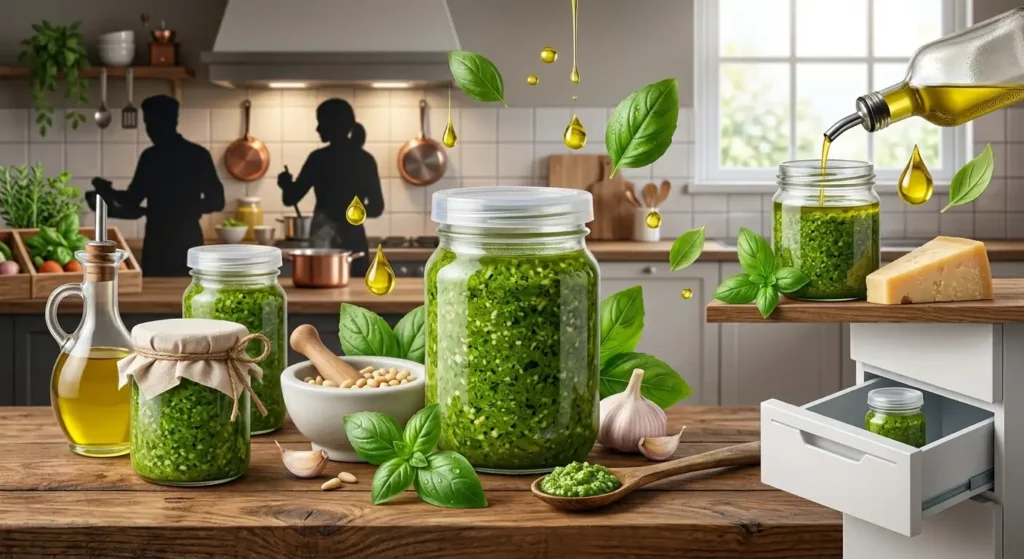
- Use a perfectly clean and sterilized container.
- Fill the jar leaving as little air as possible.
- Cover the surface with a thin layer of extra virgin olive oil.
- Seal the container tightly.
- Store in the refrigerator at a temperature between 0°C and 4°C.
The olive oil creates a protective barrier that limits oxygen exposure and helps preserve the natural green color of basil.
How to prevent pesto from turning black
Pesto darkening is mainly caused by basil oxidation.
To reduce it:
- Minimize air exposure.
- Always keep the container tightly closed.
- Maintain a constant refrigeration temperature.
- Use appropriately sized containers.
- Avoid frequently opening the jar.
A slight darkening on the surface does not necessarily mean the product is spoiled; it is usually a sign of oxidation.
Can you freeze pesto?
Yes. Freezing is one of the best methods for long-term storage of pesto.
For best results:
- Divide pesto into small portions.
- Use freezer-safe containers or bags.
- Avoid refreezing once thawed.
In the freezer, pesto can maintain its quality for several months.
Common mistakes to avoid
The most common mistakes are:
- Using non-sterilized jars.
- Leaving air inside the container.
- Storing pesto at too high temperatures.
- Using dirty utensils during serving.
- Leaving the product outside the fridge for extended periods.
Even pesto made with high-quality ingredients can spoil quickly if not stored properly.
Conclusion
Proper storage of fresh pesto requires attention to detail, from sterilizing jars and utensils to maintaining a constant cold chain. By following these simple practices, it is possible to preserve the authentic flavor of pesto, maintain its natural color, and extend its shelf life without compromising quality.