

 Maurizio Pigliacampi
 Genoese pesto
Why does pesto become bitter?
Pesto Genovese Bitter: Why It Happens and How to Avoid It
Pesto Genovese is a recipe that looks simple only at first glance. It requires few ingredients, but the balance between them is extremely delicate. When something goes wrong, the result can be bitter Pesto Genovese instead of a fresh, aromatic, and harmonious sauce.
Basil and Its Sensitivity
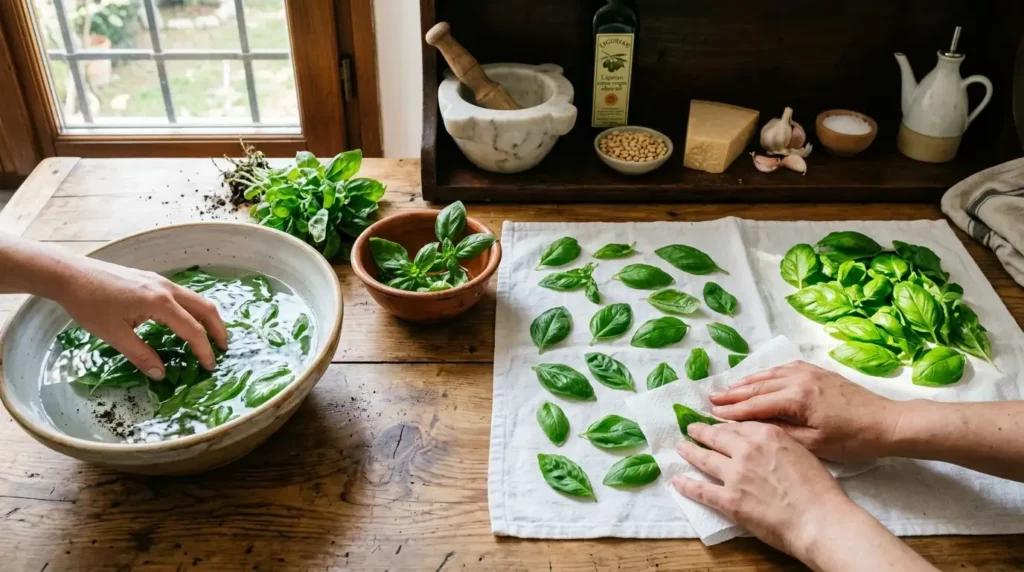
Basil is the base of Pesto Genovese and at the same time the most delicate ingredient. Its leaves contain essential oils that are easily destroyed by heat or excessive processing. When basil is heated or “stressed” during preparation, it loses its natural sweetness and can develop bitter notes.
Initial quality also matters. Old, overripe, or poorly stored basil already has a less fresh flavor, which can contribute to bitterness.
Garlic and Flavor Balance
Garlic should be present, but never dominant. If too much is used or if the inner sprout is not removed, it becomes overly aggressive and overwhelms the other ingredients. This imbalance can be perceived as bitterness, especially with less-than-perfect basil.
Olive Oil
Olive oil is one of the most important ingredients in Pesto Genovese. A too intense, bitter, or oxidized extra virgin olive oil can completely ruin the final result. Quantity is also important, because too much oil suppresses the basil.
In authentic Pesto Genovese, a fresh, fruity, and mild olive oil is used, enhancing the other ingredients without dominating them.
Pine Nuts and the Original Recipe
In the traditional Pesto Genovese recipe, pine nuts are always used raw. Toasting them is not part of the original method. Although some people do it, heat changes the flavor of the nuts and can introduce bitter notes that carry into the sauce.
Raw pine nuts add sweetness and creaminess and contribute to the balance of authentic Pesto Genovese.
Walnuts and Cashews: Why They Are Used and What Changes
In many modern versions, especially outside Italy or in industrial production, pine nuts are replaced with walnuts or cashews.
Walnuts have a stronger and slightly tannic flavor. This natural characteristic can easily lead to mild bitterness if not well balanced. Cashews are sweeter and creamier, but still different from pine nuts and with a less Mediterranean aroma.
The main reason for this substitution is not tradition but cost. Pine nuts are significantly more expensive. Walnuts and cashews reduce production costs but change the flavor profile.
Comparison with Supermarket Pesto
Industrial pesto sold in supermarkets often differs significantly from the original recipe. Due to cost and long shelf life requirements, ingredients are simplified and modified.
Walnuts or cashews are often used instead of pine nuts, cheaper oils are used, and basil is processed. This can result in a weaker taste and sometimes a sense of bitterness or flat aroma compared to homemade pesto.
Homemade or artisanal pesto focuses on freshness and balance without compromises in flavor.
Heat During Preparation
A common mistake is overheating during processing. Blending for too long or too aggressively raises the temperature and oxidizes the ingredients. This is one of the main reasons for bitter Pesto Genovese.
How to Avoid Bitter Pesto Genovese
The key is simplicity. Fresh ingredients, cold processing, and short preparation time. Basil must be handled gently, olive oil added gradually, and pine nuts used raw, as tradition dictates.
Conclusion
Bitter Pesto Genovese is not an inevitable flaw but the result of small compromises or mistakes. When the original ingredients and traditional method are respected, the result is a bright green, balanced, and aromatic sauce, very different from industrial versions.